Disclosure of AI involvement in artwork has moved from a courtesy to a requirement in many contexts: gallery submissions, print competitions, stock art platforms, and even social media captions under evolving platform policies. The difficulty is not whether to disclose, but how much detail counts as sufficient, and which wording satisfies a given venue's specific standard. A disclosure that passes for one online marketplace may be rejected by a juried exhibition that defines "AI-assisted" and "AI-generated" as separate categories with different eligibility rules.
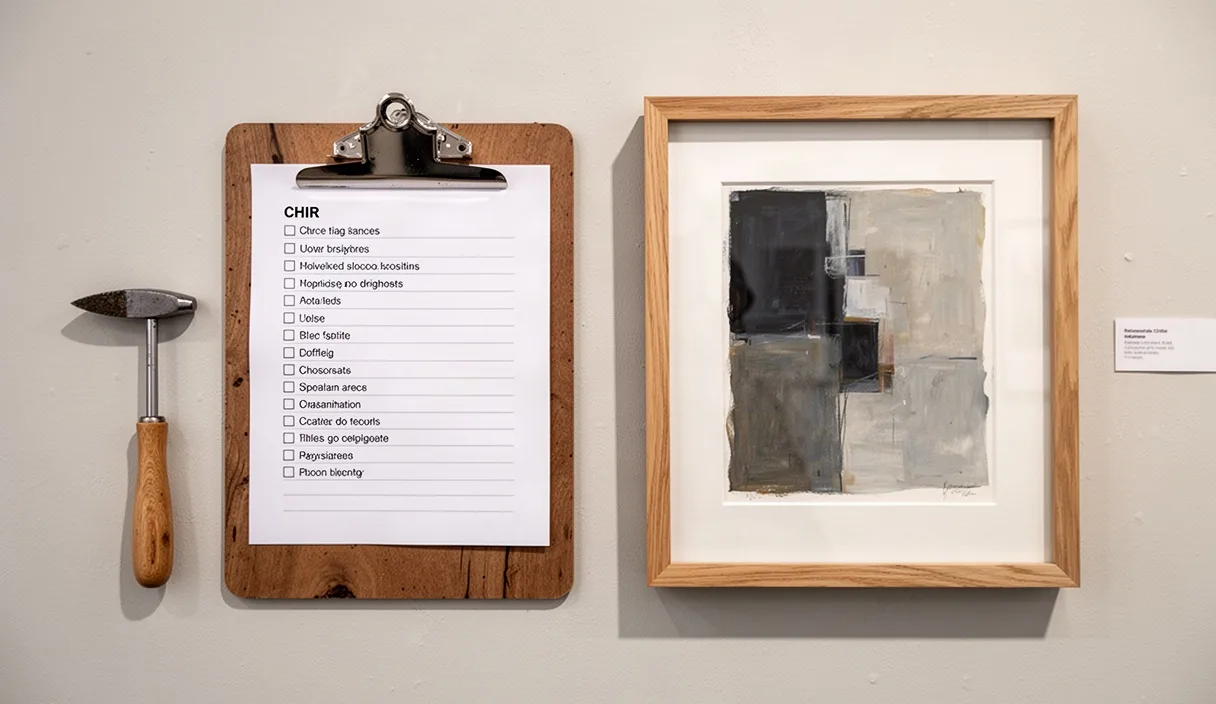
This checklist walks through the practical mechanics of disclosure: what to document while you work, how to match your statement to the venue's actual policy language, and what template to keep on hand so you are not drafting a new statement from scratch for every submission. None of this constitutes legal advice. If a contract, copyright registration, or licensing dispute is involved, consult an attorney familiar with intellectual property law in your jurisdiction.
Why Disclosure Policies Exist
Disclosure requirements exist primarily to preserve the information value of a claim like "original artwork" or "hand-painted." When a buyer, juror, or copyright office relies on that claim, they are making a decision, awarding a prize, granting a license, or recording ownership, based partly on how the work was produced. Undisclosed AI involvement breaks that chain of reliable information, regardless of the artist's intent.
A second reason is legal. The United States Copyright Office has stated in guidance documents (notably the March 2023 policy statement on works containing AI-generated material) that copyright protection extends only to the human-authored elements of a work. Material generated purely by an AI system, without sufficient human creative control over the specific expressive choices, is not protected. Disclosure during registration allows the Office to assess which parts of a work qualify, rather than granting protection to the whole piece by default.
Third, many venues have built reputational or financial consequences around the distinction. A 2023 case involved a Colorado State Fair digital art competition where a Midjourney-assisted piece won first place after disclosure, prompting the fair to clarify its rules for future years rather than retract the award. Other competitions, including several photography contests, have disqualified winners after the fact when AI tools were discovered undisclosed. The policy exists so the organizer, not the artist alone, decides what counts as acceptable practice for that specific context.
Identifying the Tools and Stages Involved
Before writing any disclosure statement, make an internal list of every tool used and the stage at which it was used. This list is for your own records first; the public-facing statement can be shorter, but you cannot shorten accurately what you have not itemized.
- Ideation stage: Did you use a language model (ChatGPT, Claude, Gemini) to brainstorm composition ideas, color palettes, or thematic concepts? This is typically the lowest-impact use and rarely requires disclosure on its own, though some venues now ask about it explicitly.
- Reference and underpainting stage: Did you generate reference images with a diffusion model (Midjourney, Stable Diffusion, DALL-E) that you then painted, drew, or photographed over? Note the percentage of the final composition that traces back to the generated reference.
- Direct generation stage: Did the final image, or a substantial portion of it, come directly from a generative model's output with minimal human editing? This is the use case most venues require disclosure for, and some prohibit outright.
- Post-processing stage: Did you use AI-powered upscaling (Topaz Gigapixel, Magnific), AI inpainting to remove objects, or AI color-correction tools? These are increasingly treated as separate from "generation" by policy writers, but not universally.
- Text and typography stage: Did an AI tool generate accompanying text, artist statements, or title suggestions? Some literary and mixed-media venues require disclosure of this separately from the visual element.
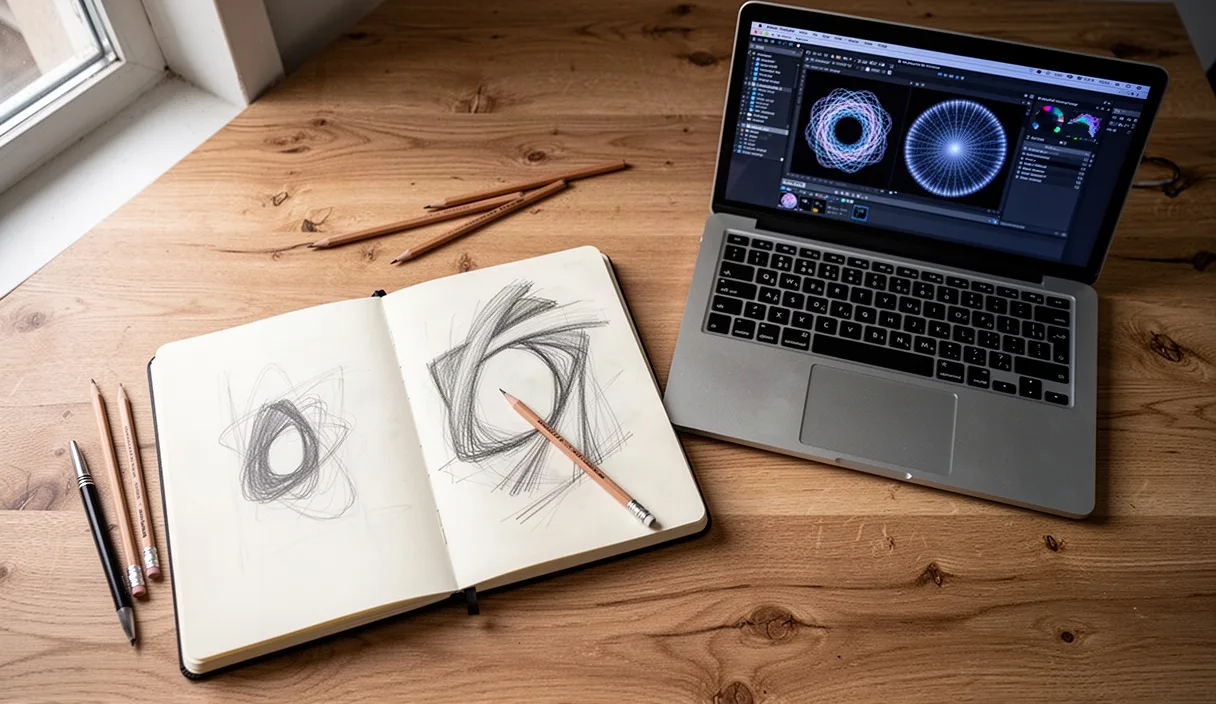
Keep dated notes, screenshots of prompts, or exported project files if your software supports version history. Procreate's timelapse export and Photoshop's history log can serve as a record if a dispute arises later about how much human revision occurred after an AI-generated starting point.
Matching Disclosure to Venue Requirements
Venues differ enough in their definitions that a disclosure written for one will often be insufficient, or inappropriate, for another. Read the specific submission guidelines every time; do not assume this year's wording matches last year's.
| Venue type | Typical requirement | Example phrasing expected |
|---|---|---|
| Open digital art competitions | Category selection (traditional vs. AI-assisted vs. AI-generated) | "This entry was created using [tool name] for [specific stage]." |
| Stock art platforms (Adobe Stock, Shutterstock) | Metadata tag or checkbox at upload, mandatory since 2023 for most platforms | Platform-provided checkbox; written description optional but recommended |
| Copyright registration (US Copyright Office) | Written description of AI-generated content excluded from the claim | "The following elements were generated by artificial intelligence and are not claimed: [list]." |
| Gallery or juried fine art shows | Varies widely; some ban AI entirely, others require a process statement | Check individual prospectus; some require a one-paragraph process note |
| Social media (Instagram, Bluesky as of 2024 policy updates) | Label or caption disclosure for "synthetic or manipulated media" in some cases | Platform label tool, or manual caption note |
Note the asymmetry: a stock platform may only need a checkbox, while a copyright filing needs a precise, itemized exclusion list because the legal consequence, what portion of the work is protected, depends on exact wording. Treat the copyright registration case as the strictest standard and default to that level of detail when you are unsure which audience will eventually see the work.
When a venue's policy is ambiguous or silent on AI, do not assume silence means permission. Email the organizer directly and keep the written response. Several open-call exhibitions in 2023 and 2024 updated their rules mid-cycle after AI-related submissions prompted complaints, and organizers who had not anticipated the question often erred toward disqualification once pressed.
Writing a Clear Disclosure Statement
A disclosure statement has three required components: the tool or tools used, the stage of the work they affected, and the extent of human revision afterward. Omitting any one of these leaves the reader guessing about the parts that matter most.
Vague statements like "AI was used in this piece" fail because they do not specify stage or extent. A juror cannot distinguish between a thumbnail-sized AI reference sketch and a fully AI-rendered final image from that sentence alone. Compare the two examples below.
- Insufficient: "This artwork incorporates AI technology."
- Sufficient: "The background landscape was generated using Midjourney v6 from an original text prompt, then composited with a hand-painted foreground figure in Procreate. Approximately 40 percent of the final pixel area originates from the AI-generated layer."
The sufficient version names the specific tool and version, states which part of the composition it affected, and gives a rough quantitative estimate. Precision does not require exact pixel counts; a good-faith estimate stated as such ("approximately," "roughly") is acceptable in nearly every venue's eyes, as long as it is not misleadingly low.
Common Mistakes in AI Disclosure
The most frequent error is disclosing the tool but not the stage, leaving reviewers to assume the worst-case interpretation. The second most frequent error is using hedging language such as "AI-inspired" or "AI-influenced" when the venue's categories require a binary choice between assisted and generated; vague category labels often get reclassified by the organizer rather than accepted as written.
A third mistake is disclosing once at submission but failing to update the statement if the work is later edited, reposted, or resold on a different platform with different requirements. A fourth is assuming that disclosure made to one party (a gallery) automatically satisfies a different party's requirement (a print-on-demand marketplace using the same image); each venue's disclosure obligation is independent.
What Happens If Disclosure Is Omitted
Consequences scale with the venue and the degree of reliance placed on the undisclosed claim. At the mild end, a social media post may simply receive a correction note or a platform-applied label after the fact. At a competition, omission discovered post-award has led to disqualification and prize forfeiture in multiple documented cases since 2022, including entries pulled from juried shows after reverse-image searches or AI-detection tools flagged inconsistencies.
At the copyright registration level, the consequence is more structural: the US Copyright Office has canceled or limited registrations when it later determined AI-generated content was not disclosed as required, as seen in the Zarya of the Dawn case in 2023, where the Office revised its position on a graphic novel's registration after learning the images were produced with Midjourney. Commercial consequences can include breach-of-contract claims if a licensing agreement warranted the work as entirely human-authored. If you are uncertain whether a past omission creates liability, a copyright attorney can assess the specific registration or contract language involved.
A Reusable Disclosure Template
Keeping a standing template saves time and reduces the chance of forgetting a required element under submission deadline pressure. Adapt the bracketed fields for each piece.
- Tool(s) used: [name and version, e.g., "Midjourney v6," "Adobe Firefly," "Stable Diffusion XL with a custom LoRA"]
- Stage(s) affected: [ideation / reference generation / direct final-image generation / post-processing / text]
- Extent of use: [approximate percentage of final composition, or a plain description such as "used only for an early thumbnail sketch, not present in final work"]
- Human contribution: [describe painting, drawing, compositing, color correction, or editing performed after the AI step]
- Date and venue: [note where this statement was submitted, since you may need a different version elsewhere]
Store completed templates alongside the project file itself, not just in a submission portal you may lose access to later. A simple text file named to match the artwork's filename, kept in the same folder as the source files, is sufficient for most independent artists. For higher-stakes situations, copyright registration, licensing negotiations, or disputes over a specific commission, treat this template as a starting draft only and have the final wording reviewed by a professional before it is submitted as a binding statement.