Portrait evaluation used to rely on a short list of visual tells: stiff hands, melted jewelry, odd teeth. Those markers still appear in some AI-generated images, but the gap has narrowed enough that relying on them alone produces both false positives and false negatives. A human artist working fast can produce an anatomically imperfect hand; a current-generation diffusion model can produce a technically correct one. Neither fact tells you, by itself, who or what made the image.
This article sets out what visual inspection can still tell you, where it breaks down, and what kinds of evidence are more reliable than a single still image. It is written for buyers, gallery staff, competition judges, and collectors who need a working method rather than a list of anecdotes.
Why Visual-Only Comparison Is Becoming Unreliable
Image generation models released after 2023 were trained on larger datasets with better hand, eye, and fabric-fold representation. The common failure modes from 2022, such as six-fingered hands or asymmetric earrings, occur far less frequently in outputs from current tools. A reviewer who checks only for those specific defects will miss a large share of synthetic images and may wrongly flag a human-made piece that happens to share a similar stylization.
Compression and resizing also erase evidence. A portrait viewed as a 1200-pixel JPEG on a marketplace listing has already lost the fine-grained texture data that would help distinguish a scanned graphite drawing from an AI output rendered in a similar style. Platforms that automatically compress uploads make this worse: artifacts introduced by compression can mimic or mask the textural cues reviewers look for.
There is also a category of hybrid work that visual inspection cannot resolve by design. An artist may sketch a composition by hand, scan it, and use an AI tool to generate color variants or backgrounds, then paint over the result. The final image carries traces of both processes, and no amount of zooming settles the question of proportion of human versus machine contribution.
Because of these limits, visual-only comparison should be treated as a first filter, not a verdict. Use it to decide whether further investigation is warranted, not as a stand-alone conclusion, particularly in any context (sales, competitions, authentication) with financial or reputational consequences.
Brushstroke and Texture Markers: What Still Holds
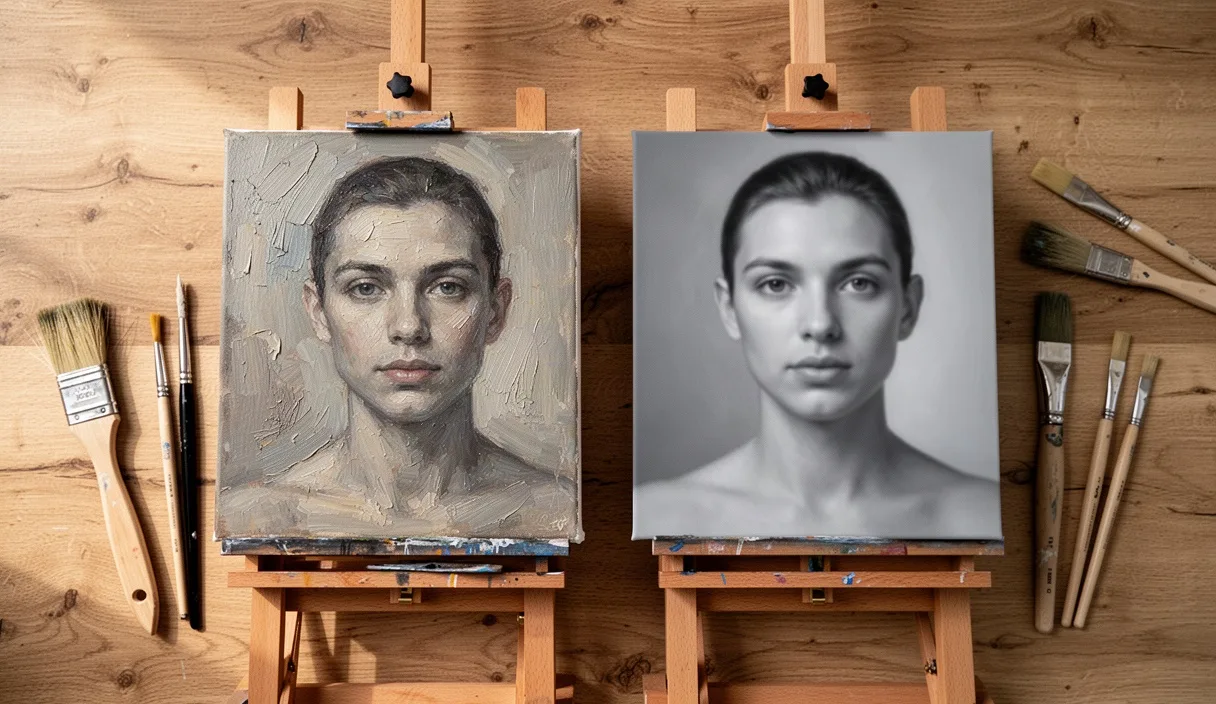
Traditional media leave physical evidence that generative models do not reproduce by default. Graphite and charcoal drawings show directional pressure variance: lines are heavier where the artist pressed down and lighter at stroke ends, with visible tool drag at edges. In an AI-generated image styled to look like a pencil drawing, this pressure logic is usually absent or inconsistent across the frame, because the model is approximating the visual texture of graphite without simulating a tool moving across paper.
Oil and acrylic paintings show impasto, the raised ridges of paint that catch light differently depending on viewing angle. This is visible in a raking-light photograph (light source at a low angle to the canvas) but invisible in a flat scan or a frontal phone photo. If a seller cannot or will not provide a raking-light image or video of a claimed oil painting, that is a reasonable point to ask about directly, though its absence does not by itself prove the work is synthetic.
Digital paintings made in software like Procreate or Photoshop leave layer history and brush-stroke metadata if the artist exports a process video or a layered file. AI-generated images typically have no such history, since they are produced in a single inference pass or a short series of denoising steps. Asking for a time-lapse export, which most digital painting apps can generate natively, is a practical and low-friction verification step.
- Graphite/charcoal: check for pressure variance and tool drag at line ends.
- Oil/acrylic: request a raking-light photo or video to check for impasto.
- Digital painting: request a layered file or time-lapse export.
- Watercolor: check for pigment granulation and bloom edges, which are difficult to fake convincingly at close inspection.
Anatomical and Proportional Consistency Checks
Anatomical checks remain useful but need to be applied more narrowly than in the past. The most persistent AI tell is not missing fingers but inconsistent object permanence across small repeated elements: earring pairs that differ in design, buttons that do not align with a visible buttonhole, or patterned fabric where the pattern does not continue logically around a fold. These errors occur because generative models render local regions with high fidelity but do not always enforce global consistency across the full image.
Hands remain a weaker point for many tools, but the specific failure has shifted from extra fingers to incorrect joint counts or impossible wrist rotation. Check whether each finger has three visible segments and whether the thumb's attachment point to the palm is anatomically plausible. A human artist unfamiliar with hand anatomy may also get this wrong, so this check indicates technical skill level, not necessarily authorship.
Ears and teeth are worth checking in close portrait crops. AI models sometimes render teeth with an incorrect count or uneven spacing that does not match any real dental pattern, and ear cartilage folds can appear smoothed into a generic shape rather than following the sitter's actual ear structure (relevant mainly for portraits of real identifiable people, such as commissioned likenesses).
None of these checks are reliable in isolation. Treat them as cumulative evidence: one odd button is not meaningful, but three or four small inconsistencies clustered in one image shift the likelihood assessment meaningfully.
Lighting Logic and Physical Plausibility
Light in a physically painted or photographed scene follows a single consistent source (or a documented set of sources, such as studio lighting with a key and fill). Shadows should fall in the same direction, and reflected highlights in eyes, jewelry, and glass should correspond to the same light position. Generative models increasingly handle single-source lighting well, but multi-element scenes, such as a figure holding a reflective object next to a window, still occasionally produce mismatched highlight directions.
Check cast shadows against the implied light source. If a figure's shadow suggests a light source to the upper left but a glass of water on the table shows a highlight consistent with a light source to the right, that is a meaningful inconsistency. This check requires a reasonably high-resolution image; it does not work well on small thumbnails.
Reflections in eyes (catchlights) are a specific sub-check worth learning. In a photograph or a carefully observed painting, both eyes typically show a catchlight in the same relative position, because both eyes are receiving light from the same source at a similar angle. Some AI-generated portraits show catchlights in different positions in each eye, or a catchlight that does not correspond to any visible or implied light source in the frame.
Physical plausibility also covers material behavior: how fabric drapes under gravity, how hair strands separate near the scalp versus clump near the ends, and how metal versus glass reflects differently. These are learnable patterns for both human artists and AI models, so they indicate rendering sophistication more than they definitively indicate origin.
Series Analysis Versus Single-Image Analysis
A single image, however carefully examined, gives limited evidence. Reviewing a body of work from the same claimed artist or tool across ten or twenty pieces reveals patterns that no single image shows. Human artists tend to have consistent anatomical quirks (a particular way of drawing noses or hands) that repeat because they reflect learned habits. AI tools, particularly when used with a consistent prompt template or seed range, also produce repeating patterns, but these tend to be compositional (similar framing, similar pose angles) rather than tied to a specific habitual mark-making error.
Look for variation in error type across a series. A human artist who sometimes draws hands well and sometimes poorly, depending on the pose difficulty, is behaving consistently with manual skill variation. A series where every hand shares the exact same structural error, regardless of pose, points toward a shared generative process rather than independent manual execution of each piece.
For portfolio review, request at least five to ten comparable pieces rather than judging from one. If an artist or seller can provide only a single finished image with no earlier works, no process material, and no variations, treat that as a gap in available evidence rather than proof of anything, and factor it into your confidence level accordingly.
Why Process Documentation Outweighs Visual Inspection
Visual inspection, even applied thoroughly across the categories above, produces a probability assessment, not a certainty. Process documentation changes the nature of the evidence. A timestamped layer file from Photoshop or Procreate, a video recording of the work in progress from blank canvas to finished piece, or a set of progress photographs taken over the course of several sessions are harder to fabricate convincingly and correspond directly to a verifiable manual process.
For traditional media, request progress photographs showing the piece at roughly 25%, 50%, and 75% completion, ideally with a visible date or a handwritten note in frame. For digital work, request the native file (.psd, .procreate, .clip) rather than a flattened export; native files preserve layer order and often timestamp metadata that is difficult to fake without specialized effort.
For high-value purchases or competition submissions, consider requiring a live demonstration, such as a video call where the artist works on a small portion of a similar piece in real time. This is a reasonable request for commissions above a few hundred dollars or for competition entries with cash prizes, and most working artists will not object to a short, proportionate verification step.
If the stakes involve a legal dispute, such as a copyright claim or a contested competition result, process documentation of this kind is generally more useful to an attorney or arbitrator than visual stylistic argument, though specific evidentiary standards vary by jurisdiction and venue; consult a qualified professional for guidance in that context rather than relying on the checks in this article.
A Short Comparison Table for Quick Reference
| Check | Still reliable | Limitations |
|---|---|---|
| Finger/hand anatomy | Moderately | Both skilled AI and skilled humans now render hands correctly |
| Catchlight consistency | Moderately | Requires high resolution; some tools now handle this correctly |
| Impasto / raking light | High for claimed oil/acrylic | Only applies to physical paint media, not digital or print |
| Pattern continuity on fabric | Moderately | Small, localized; easy to miss on first pass |
| Layer file / time-lapse | High | Requires artist cooperation; can be staged with effort |
| Series-wide error pattern | High | Requires access to multiple pieces, not always available |
Common Mistakes
Treating a single anatomical flaw as conclusive proof of AI generation is the most frequent error; skilled but rushed human artists make comparable mistakes. The reverse error, assuming an anatomically flawless image must be human-made, is equally common and equally unreliable given current tool quality.
Judging from a compressed thumbnail is another recurring mistake. Request the highest-resolution file available before applying any of the texture or lighting checks described above, since compression artifacts can both hide genuine evidence and introduce false ones.
Finally, reviewers sometimes skip process documentation requests because they feel confrontational. Framing the request as a standard step applied to all submissions, rather than a personal accusation, tends to get a more cooperative response and produces more consistent evaluation across a competition or marketplace.
Next Steps
Start by applying the visual checks in this article as a screening pass, then decide whether the result is clear enough to act on or whether it needs process documentation before a decision is made. For purchases or competition entries where the outcome has financial weight, request progress files or a short live demonstration as a standard condition rather than an exception. For disputed cases with legal implications, document what you observed and consult an attorney or a relevant professional body before making a public claim about an image's origin.