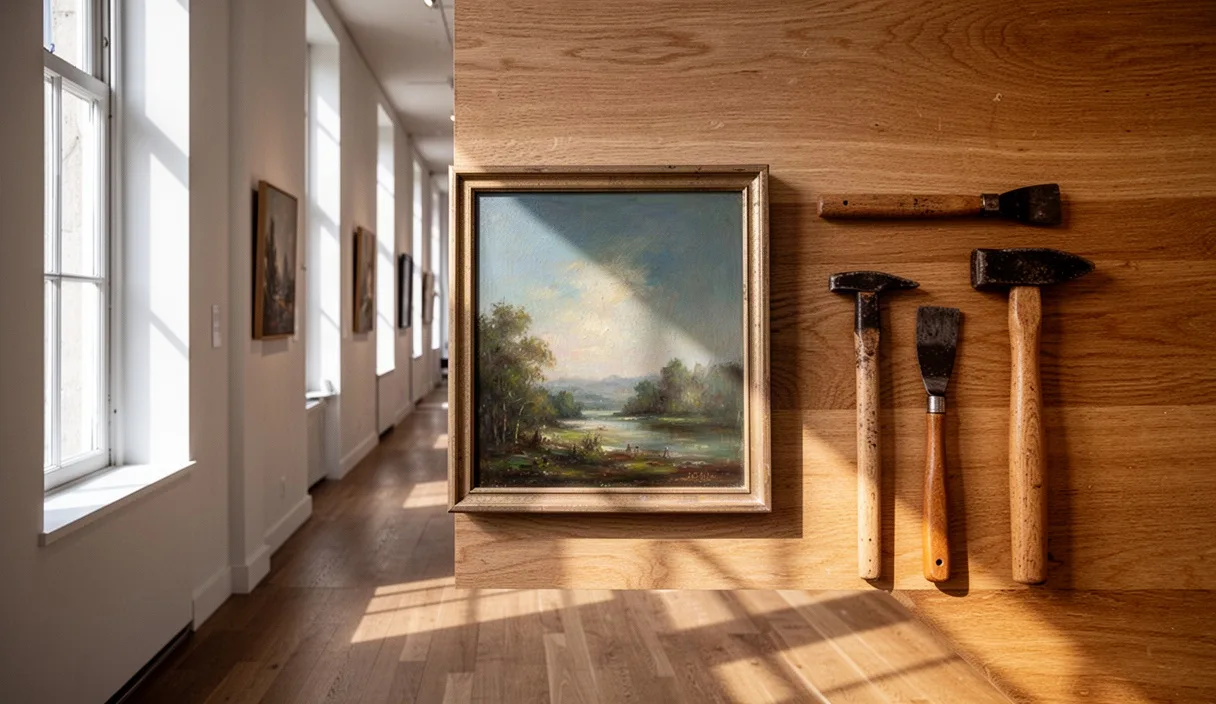
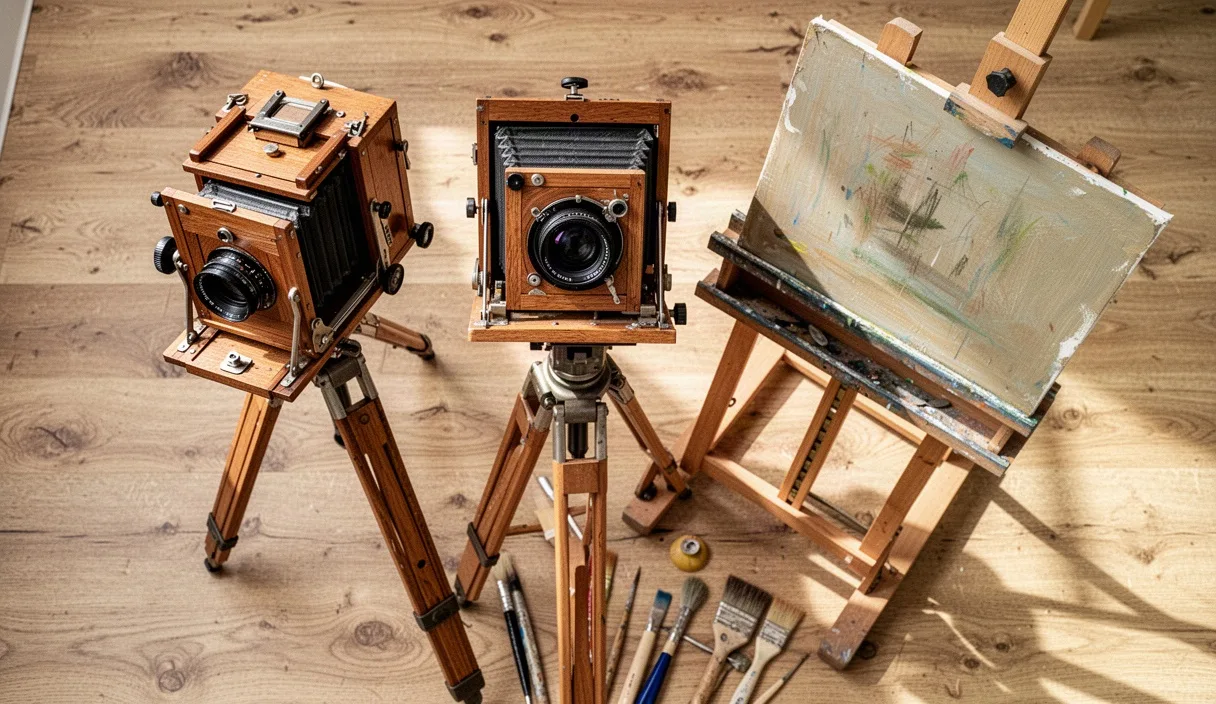

When critics reach for a historical precedent to explain generative AI's disruption of creative work, they almost always land on photography. The comparison is useful but frequently applied carelessly, with quotes misattributed and timelines compressed to fit the argument. Photography's nineteenth century arrival did displace specific occupations and did force painting to redefine its purpose, but the process took far longer, followed a more complicated path, and resolved questions that AI has not yet reached a comparable stage on.
This article separates the parts of the photography analogy that hold up under scrutiny from the parts that collapse once you check dates, institutional records, and labor data. The goal is not to settle whether AI will "do to illustration what photography did to painting," but to give readers a documented baseline against which to test that claim.
The Original Obsolescence Argument Against Photography
Louis Daguerre announced the daguerreotype process to the French Academy of Sciences in 1839, and within months studios offering photographic portraits opened in Paris, London, and New York. The painter Paul Delaroche is widely quoted as declaring "from today, painting is dead" on seeing an early daguerreotype. No primary source from Delaroche's lifetime documents this statement; the quote first appears in print decades after his death in 1856, which means it should be treated as an attributed tradition rather than a confirmed fact.
The economic anxiety behind the quote was real even if the quote itself is apocryphal. Miniature portrait painting, a trade built on small, fast, relatively affordable likenesses, was the segment most directly exposed. Royal Academy exhibition catalogs from London show miniature submissions falling sharply between the 1840s and 1860s, as sitters who wanted an affordable, accurate likeness increasingly chose a daguerreotype or, after 1851, an ambrotype instead of commissioning a painted miniature.
The displacement was occupation-specific rather than medium-wide. History painters, portraitists working in oil for wealthy patrons, and landscape artists did not see comparable drops in commissions during this period. The group most affected was narrow: practitioners whose entire business model depended on speed and affordability rather than interpretive or technical ambition.
How Painting's Function Actually Changed
Painting did not disappear after photography captured the documentary portrait market; it relocated its claimed function. Realist and later Impressionist painters shifted emphasis toward subjective perception, atmosphere, and the act of seeing itself, areas a mechanical process could not replicate in the 1860s and 1870s. The first Impressionist exhibition took place in 1874, thirty-five years after Daguerre's announcement, which is a long gap for a "replacement" narrative to require before the replaced medium finds its new ground.
Several painters used photography as a working tool rather than treating it purely as a competitor. Edgar Degas photographed dancers and used the images as compositional references. Eugene Delacroix collected photographic studies of nudes for studio use. The relationship was additive in these cases, not purely substitutive.
The functional reallocation took specific, documentable forms: painting moved toward abstraction, expressive color, and non-representational concerns across the following decades, culminating in movements like Fauvism (1905) and Cubism (1907-1912) that had no photographic equivalent at all. The market for painted portraiture of the wealthy persisted throughout, since oil portraits retained social status value that photographs did not initially carry.
The Multi-Decade Path to Institutional Acceptance
Photography's acceptance as a fine art, rather than a mechanical or documentary craft, took close to a century to formalize in major institutions. The Paris Salon admitted photography starting in 1859, but kept it in a separate section from painting and sculpture, a bureaucratic distinction that signaled lesser status rather than parity.
Alfred Stieglitz founded the Photo-Secession movement in 1902 and published Camera Work from 1903 to 1917 specifically to argue for photography's standing as an art form deserving gallery and museum treatment equal to painting. This was a deliberate, decades-long advocacy campaign, not a spontaneous cultural shift.
The Museum of Modern Art in New York established a dedicated department of photography in 1940, with Beaumont Newhall as its first curator. That date is 101 years after Daguerre's original announcement. Institutional legitimacy, measured by acquisition policy and curatorial department status, lagged the technology's invention by roughly a century and lagged its first practical use by photographers seeking artistic recognition by about forty years.
Where the Labor Displacement Parallel Holds
The clearest point of continuity between photography's arrival and AI's current rollout is task-level rather than occupation-level displacement. Miniature portraitists lost work because a specific task, fast affordable likeness production, was captured by a cheaper substitute. The occupation of "painter" survived; the task of "cheap portrait production" moved to a new medium.
New hybrid roles emerged alongside the displacement. By the 1860s and 1870s, hand-tinting black and white photographs with watercolor or oil-based pigments became a recognized trade, often performed by painters who had lost miniature commissions and redirected their skill toward coloring photographic prints. Studio photography also created entirely new occupations: camera operators, darkroom technicians, retouchers, and photographic colorists did not exist as job categories before 1839.
Current AI debates show a similar pattern at the task level. Stock photography and certain categories of commercial illustration, work defined by speed and template-like repetition rather than singular authorship, show the earliest and clearest effects. Occupations built on judgment, direction, and context, such as art direction or editorial illustration tied to a specific narrative brief, show less direct displacement so far, though data on this is still early and should be treated as provisional rather than conclusive.
Where the Historical Parallel Breaks Down
The most significant break is diffusion speed. Photography required specialized chemical knowledge, darkroom access, and equipment that cost a meaningful sum relative to average wages; a basic daguerreotype outfit in the 1840s cost roughly the equivalent of several weeks of a skilled laborer's pay. Mass consumer adoption did not arrive until the Kodak Brownie camera launched in 1900, sixty-one years after the daguerreotype's announcement. AI image and text tools, by contrast, are frequently free or low-cost and accessible through a browser within minutes of release.
| Factor | Photography (1839 onward) | Generative AI (2022 onward) |
|---|---|---|
| Time from invention to mass consumer access | About 61 years (to the Brownie camera) | Months, often under a year |
| Entry cost at launch | Equivalent to weeks of wages | Free or low subscription cost |
| Domain affected | Visual still imagery only | Text, image, audio, video, code simultaneously |
| Institutional art-world acceptance | Roughly a century (MoMA department, 1940) | Not yet established; contested |
A second break concerns training data and provenance. A camera records light falling on a scene; it does not require prior human-made images to function. Generative AI models are trained on large corpora of existing human-made text, images, and audio, which raises consent and compensation questions that chemical photography never posed. This difference matters for any legal or ethical argument built on the photography analogy, since the two technologies rest on fundamentally different relationships to prior human work.
What This History Does Not Predict
The photography precedent describes a shape of transition, task reallocation followed by a slow institutional sorting process, but it does not predict specific outcomes for AI. It does not tell us whether AI-generated work will eventually receive gallery and museum treatment comparable to photography's, nor on what timeline, since the underlying mechanics of production and attribution differ substantially.
It also does not resolve current copyright and authorship questions. Whether an AI-assisted image, text, or composition qualifies for copyright protection, and under what conditions, is an active legal matter that varies by jurisdiction and is still being litigated and legislated as of this writing. Readers facing a specific contract, licensing, or infringement question should consult an intellectual property attorney rather than rely on historical analogy for guidance.
Finally, the history does not guarantee that displaced practitioners will find comparable hybrid roles this time. The emergence of photographic colorists and studio retouchers in the 1860s was not inevitable; it depended on specific market conditions, including continued demand for colored images before practical color photography existed after the 1930s. Current labor markets may or may not generate equivalent hybrid roles for displaced illustrators, copywriters, or designers, and this should be treated as an open empirical question rather than a settled prediction.
Applying These Lessons to Current AI Debates
Three specific, checkable markers can help track where current AI debates sit relative to the photography timeline. First, watch for task-level displacement data broken out by occupation rather than aggregate "creative jobs" figures, since the miniature portraitist and the history painter experienced 1839 very differently. Second, watch institutional acceptance markers directly, such as major museum acquisition policies for AI-assisted work and award body rulings.
One concrete current marker already exists: in 2023, photographer Boris Eldagsen won a category at the Sony World Photography Awards with an AI-generated image and then declined the prize, stating the piece was submitted to test whether the competition could distinguish AI output from photography. This episode functions as a present-day equivalent to the 1859 Salon debate over whether photography belonged in the same category as painting, and it is a useful case to cite with its actual date and outcome rather than in vague terms.
Third, track adaptation patterns among practitioners rather than only displacement statistics. The painters who moved into photographic colorizing in the 1860s did so because they identified a specific adjacent task that still required manual skill. Readers currently navigating AI's effect on their own field may find it useful to map their own task list the same way, separating which parts of their work are template-like and exposed versus which depend on judgment, client relationship, or context that current tools do not reliably replicate.
Common mistakes
- Citing the Delaroche "painting is dead" quote as a documented historical fact rather than an undated, posthumously attributed tradition.
- Treating photography as having "replaced" painting broadly, when the actual effect was concentrated in specific genres such as miniature portraiture.
- Collapsing photography's diffusion timeline, confusing the 1839 invention date with mass adoption, which did not arrive until the 1900 Brownie camera.
- Assuming the photography precedent resolves current copyright or authorship disputes, which remain active legal questions requiring current statute and case law rather than historical inference.
Next steps for readers tracking this debate
Readers who want to use this history productively rather than rhetorically should start by separating claims into three categories: documented facts with primary sources, widely repeated but unverified quotes or anecdotes, and open empirical questions with no current answer. The Delaroche quote belongs in the second category; the MoMA photography department's 1940 founding belongs in the first; and whether AI-assisted creative work will achieve comparable institutional status belongs in the third.
For practitioners assessing their own exposure, a practical exercise is to list current work tasks and mark which ones resemble the 1840s miniature portrait trade, fast, template-like, price-sensitive, versus which resemble history painting or Impressionist experimentation, judgment-driven and context-specific. For questions involving contracts, licensing, or intellectual property ownership of AI-assisted work, consult a qualified attorney, since this area is governed by current and evolving law that general historical analogy cannot substitute for. For labor market data specific to a given field, professional associations and published occupational statistics will offer more current and reliable figures than analogy-based prediction.